


 Sign out
Colon cancer screening saves lives through early detection
A timely preventive test reveals that Rebecca Kucera has cancer. Early detection and swift treatment get her back to traveling and spending time with her family.
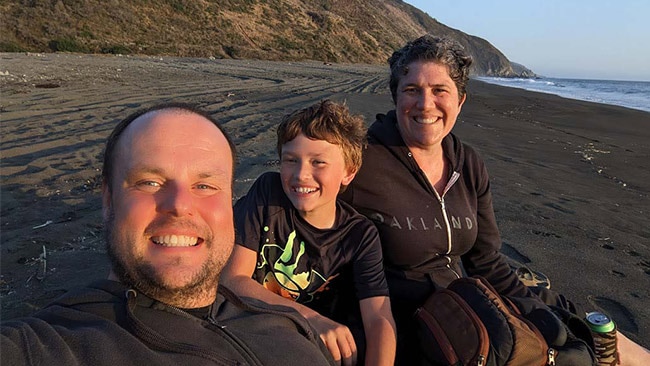
Rebecca Kucera (right) enjoys a day at the beach with her husband, Martin, and their son, Enzo.
Shortly after Rebecca Kucera turned 45, she went out to dinner with a group of friends. They’d gone to high school together and were about the same age.
Several were Kaiser Permanente members and had recently received at-home colon cancer test kits. Most people should begin screening for colon cancer at age 45.
“We joked with each other, ‘Did you get your birthday present?’” said Kucera, who works for the Kaiser Permanente Division of Research in Northern California.
Kucera knew cancer screening was important. But she’d been putting it off. That night, the friends all agreed to prioritize their health and send in their kits as soon as possible.
Convenient home colon cancer test
The test that Kucera and her friends received is called FIT, short for fecal immunochemical test. It checks for hidden blood in the stool. The kit comes with simple instructions for how to collect a sample at home and send it to a lab.
Soon after Kucera completed her test, her doctor reached out to schedule a colonoscopy, the standard next step if a FIT test is positive.
Colonoscopies allow doctors to look at the inner lining of the rectum and large intestine. This can help them find out why there is blood in the stool.
Sometimes, blood may be from ulcers or areas of inflammation. It can also be caused by abnormal growths called polyps.
Not all polyps are cancerous. But some are, and others may turn into cancer later.
During Kucera’s colonoscopy, her doctor removed several polyps. But one was larger and required a second colonoscopy and treatment from a specialist.
Colon cancer prevention starts with early detection
Kucera went in for a second colonoscopy. Rosa Valadao, MD, a gastroenterologist for Kaiser Permanente in Northern California, removed the large polyp and had it tested.
It was positive for cancer. But since it was caught so early, Kucera’s prognosis was very good.
She had surgery to remove a small portion of her large intestine to make sure the cancer wouldn’t spread. The surgery was a success. Kucera recovered quickly and didn’t need chemotherapy or radiation.
“Early detection is the key to my story,” Kucera said.
Dr. Valadao agrees. “Colon cancer survival rates are much higher when we find it before it spreads to other parts of the body,” she said. “Regular screenings save lives.”
Colon cancer screening recommendations
Colon cancer is the second most common cause of cancer deaths in the U.S.
And colon cancer rates in younger people have been on the rise in recent decades. That’s one reason why the recommended age to start screening was recently lowered from 50 to 45.
People with higher risk, including those with a family history of colon cancer, may need to start at an earlier age. Talk with your doctor about when you should start colon cancer screenings.
“Many of my patients feel perfectly fine, just like Rebecca did,” said Dr. Valadao. “Often, the only sign that they have colon cancer is their positive FIT.”
Colon cancer screening saved her life
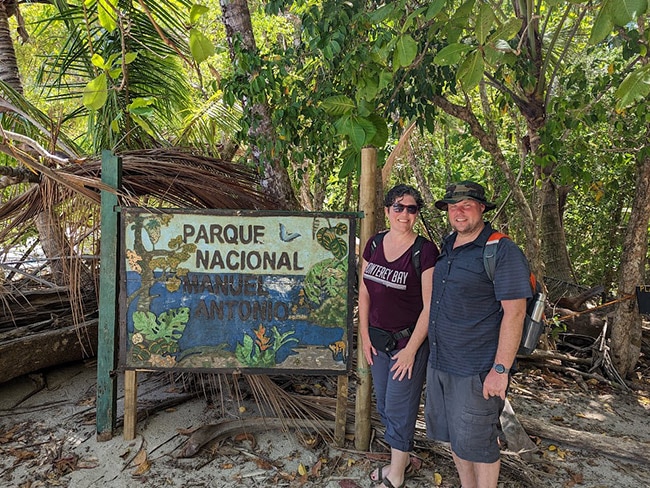 Rebecca Kucera in Costa Rica with her husband, Martin.
Today, Kucera is back to doing the things she loves. She cooks often and enjoys hiking and traveling with her family.
She urges friends and family to keep up with colorectal cancer screening. “If I’d waited even just a couple of years, everything could have been a lot worse.”
Learn more about cancer care at Kaiser Permanente.
Colon cancer symptoms
Colorectal cancer often doesn’t cause symptoms until it’s already advanced and has started to spread. That’s why early detection is so important.
The most common symptoms are:
- Blood in your stools, and/or very dark stools, or both
- More frequent bowel movements
- Feeling like your bowels don’t empty completely
- New iron deficiency anemia
Colon cancer prevention
Smoking, drinking alcohol, being overweight, and not getting enough exercise can increase your risk of colon cancer.
To lower your risk of colon cancer, you can:
- Quit smoking
- Reduce alcohol consumption
- Maintain a healthy weight
- Get regular physical activity
Talk to your doctor about other things you can do to help prevent cancer.