Overview
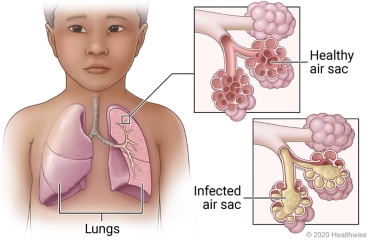
Walking pneumonia is an infection of the lungs that's often caused by the mycoplasma bacteria.
Cold-like symptoms of cough, sore throat, headache, feeling tired, and a low fever start slowly. The infection is usually so mild that your child may walk around with it without knowing they have it. Most children don't get sick enough to be in the hospital. It's more common in younger people.
Walking pneumonia is usually treated with antibiotics.
Your child's cough may last for a few weeks after the infection has been treated. They may have some wheezing too. These symptoms will go away over time.
Follow-up care is a key part of your child's treatment and safety. Be sure to make and go to all appointments, and contact your doctor if your child is having problems. It's also a good idea to know your child's test results and keep a list of the medicines your child takes.
How can you care for your child at home?
- If the doctor prescribed antibiotics for your child, give them as directed. Do not stop using them just because your child feels better. Your child needs to take the full course of antibiotics.
- Ask your doctor if you can give your child acetaminophen (Tylenol) or ibuprofen (Advil, Motrin). Be safe with medicines. Read and follow all instructions on the label. Do not give aspirin to children and teens. It has been linked to Reye syndrome, a rare but serious illness.
- Be careful with cough and cold medicines. Don't give them to children younger than 6. They don't work for children that age and can even be harmful. For children 6 and older, always follow all the instructions carefully. Make sure you know how much medicine to give and how long to use it. Use the dosing device if one is included.
- Make sure your child rests, especially if they have a fever.
- Have your child drink plenty of fluids.
- Teach good oral care to reduce bacteria in the mouth.
- Keep your child away from smoke and the aerosol mist from vaping. Do not smoke or vape around your child or in your house, and avoid being around others who are smoking or vaping.
When should you call for help?
Call 911 anytime you think your child may need emergency care. For example, call if:
- Your child has severe trouble breathing. Symptoms may include:
- Using the belly muscles to breathe.
- The chest sinking in or the nostrils flaring when your child struggles to breathe.
Contact your doctor now or seek immediate medical care if:
- Your child has new or worse trouble breathing, such as wheezing.
- Your child has a new or higher fever.
- Your child coughs up dark brown or bloody mucus (sputum).
- Your child has new symptoms, such as a rash, an earache, or a sore throat.
Watch closely for changes in your child's health, and be sure to contact your doctor if:
- Your child's cough has not gone away after 2 to 4 weeks.
- Your child does not get better as expected.
Where can you learn more?
Go to http://www.healthwise.net/patientEd
Enter S568 in the search box to learn more about "Walking Pneumonia in Children: Care Instructions".
Current as of: February 27, 2026
Author: WebMD Ignite Staff
Clinical Review Board
All WebMD Ignite education is reviewed by a team that includes physicians, nurses, advanced practitioners, registered dieticians, and other healthcare professionals.