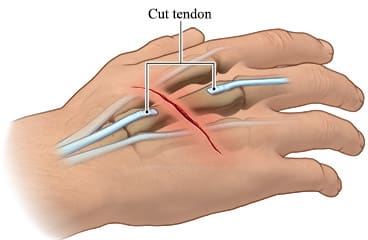
When a tendon in your hand is cut (lacerated), moving your fingers can be hard to do. Tendons are tough, flexible, ropy fibers that connect muscle to bone. The tendons allow the fingers to move.
The tendons in the palm of your hand are called flexors. If a flexor is cut, you may not be able to bend your fingers. The tendons that run over your knuckles and down the back of your hand are called extensors. If an extensor is cut, you might not be able to straighten the fingers.
Your doctor has examined your hand and asked you to try to move your fingers. This helped find which tendon was cut. The doctor also checked to see if the blood vessels and nerves in your fingers were damaged.
Your treatment depends on how bad the cut is.
If the tendon is completely cut, you will need surgery to repair it. The surgery is usually done within 7 to 10 days. The doctor may close the wound with stitches, bandage it, and put your hand or finger in a splint until then.
If the tendon is partially cut, your doctor may let it heal without surgery. You may get stitches to close the wound. Then the doctor may bandage your hand or finger and put it in a splint.
In either case, you may have to wear the splint for up to 2 months while the tendon heals. It may take 1 more month before you can use your hand as before.
Follow-up care is a key part of your treatment and safety. Be sure to make and go to all appointments, and call your doctor if you are having problems. It's also a good idea to know your test results and keep a list of the medicines you take.
How can you care for yourself at home?
Be safe with medicines. Read and follow all instructions on the label.
If the doctor gave you a prescription medicine for pain, take it as prescribed.
If you are not taking a prescription pain medicine, ask your doctor if you can take an over-the-counter medicine.
Put ice or a cold pack on your hand for 10 to 20 minutes at a time. Try to do this every 1 to 2 hours for the next 3 days (when you are awake) or until the swelling goes down. Put a thin cloth between the ice and your skin.
Prop up the sore hand on a pillow anytime you sit or lie down during the next 3 days. Try to keep it above the level of your heart. This will help reduce swelling.
Keep the cut dry for the first 24 to 48 hours. After this, you can shower if your doctor okays it. Pat the cut dry.
Don't soak the cut, such as in a bathtub. Your doctor will tell you when it's safe to get the cut wet.
If your doctor put a splint on your hand or finger, wear the splint exactly as directed. Do not remove it until your doctor says that you can.
When should you call for help?
Call your doctor now or seek immediate medical care if:
Your hand or finger is cold or pale or changes color.
You have new pain, or your pain gets worse.
You have tingling, weakness, or numbness in your hand or finger.
You have symptoms of infection, such as:
Increased pain, swelling, warmth, or redness around the cut.
Red streaks leading from the cut.
Pus draining from the cut.
A fever.
Watch closely for changes in your health, and be sure to contact your doctor if:
Clinical Review Board All Ignite Healthwise, LLC education is reviewed by a team that includes physicians, nurses, advanced practitioners, registered dieticians, and other healthcare professionals.
Clinical Review Board All Ignite Healthwise, LLC education is reviewed by a team that includes physicians, nurses, advanced practitioners, registered dieticians, and other healthcare professionals.
This information does not replace the advice of a doctor. Ignite Healthwise, LLC disclaims any warranty or liability for your use of this information. Your use of this information means that you agree to the Terms of Use and Privacy Policy.
The Health Encyclopedia contains general health information. Not all treatments or services described are covered benefits for Kaiser Permanente members or offered as services by Kaiser Permanente. For a list of covered benefits, please refer to your Evidence of Coverage or Summary Plan Description. For recommended treatments, please consult with your health care provider.


 Sign out