What is a needle biopsy of the lung?
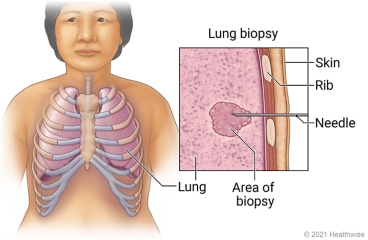
A needle lung biopsy is a procedure to take a sample of lung tissue. The doctor puts a long needle through your chest to do this. The sample lung tissue is examined under a microscope to check for infection, cancer, or other lung problems. This procedure is also called a percutaneous (say "per-kew-TAY-nee-us") biopsy.
Your doctor will use a CT scan, ultrasound, or fluoroscopy to guide the biopsy needle. The place where your doctor inserts the needle is cleaned first with an antiseptic solution and draped with sterile towels. Your doctor will give you a numbing medicine to keep you from feeling any pain when the needle is inserted into your chest.
Your doctor will then make a small puncture in your skin and ask you to hold your breath while the biopsy needle is inserted into your lung. It is very important to avoid coughing or moving while the needle is in your chest.
After the lung tissue sample is taken, the needle is removed and a bandage is placed over the puncture site. Your care team will position you so that the needle puncture site can seal up. You will need to stay in this position for at least an hour.
You will probably go home several hours after the procedure.
It can take several days to get the results of the biopsy. The doctor will discuss the results with you.
How do you prepare for the procedure?
Procedures can be stressful. This information will help you understand what you can expect. And it will help you safely prepare for your procedure.
Preparing for the procedure
- Understand exactly what procedure is planned, along with the risks, benefits, and other options.
- Tell your doctor ALL the medicines, vitamins, supplements, and herbal remedies you take. Some may increase the risk of problems during your procedure. Your doctor will tell you if you should stop taking any of them before the procedure and how soon to do it.
- If you take aspirin or some other blood thinner, ask your doctor if you should stop taking it before your surgery. Make sure that you understand exactly what your doctor wants you to do. These medicines increase the risk of bleeding.
- Make sure your doctor and the hospital have a copy of your advance directive. If you don’t have one, you may want to prepare one. It lets others know your health care wishes. It’s a good thing to have before any type of surgery or procedure.
- Be sure you have someone to take you home. Anesthesia and pain medicine will make it unsafe for you to drive or get home on your own.
What happens on the day of the procedure?
- Follow the instructions exactly about when to stop eating and drinking. If you don't, your procedure may be canceled. If your doctor told you to take your medicines on the day of the procedure, take them with only a sip of water.
- Take a bath or shower before you come in for your procedure. Do not apply lotions, perfumes, deodorants, or nail polish.
- Take off all jewelry and piercings. And take out contact lenses, if you wear them.
At the hospital or surgery center
- Bring a picture ID.
- You will be kept comfortable and safe by your anesthesia provider. You may get medicine that relaxes you or puts you in a light sleep. The area being worked on will be numb.
- The biopsy will take 30 to 60 minutes.
- After the biopsy, you will need to lie on your side for at least 1 hour. This can help stop bleeding from the area of the lung where the biopsy was done.
- An X-ray of your lungs will be taken after the procedure.
When should you call your doctor?
- You have questions or concerns.
- You don't understand how to prepare for your procedure.
- You become ill before the procedure (such as fever, flu, or a cold).
- You need to reschedule or have changed your mind about having the procedure.
Where can you learn more?
Go to http://www.healthwise.net/patientEd
Enter Q187 in the search box to learn more about "Percutaneous Lung Biopsy: Before Your Procedure".
Current as of: July 31, 2024
Author: Ignite Healthwise, LLC Staff
Clinical Review Board
All Ignite Healthwise, LLC education is reviewed by a team that includes physicians, nurses, advanced practitioners, registered dieticians, and other healthcare professionals.