Noncancerous Ovarian Growths: Care Instructions

Skip Navigation

Overview

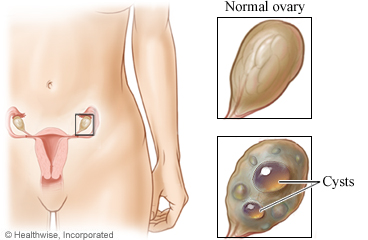
Location of ovaries, with detail of normal ovary and ovary with ovarian cysts.

Ovarian growths are abnormal growths in or on the ovaries. The growth can be a cyst, which is a fluid-filled sac, or a mass (neoplasm), which is a more solid growth.

Most of these growths are not cancerous (benign) and don't cause symptoms. If you have symptoms, they may include pain in the belly or pelvis, pain during your period, and abnormal bleeding.

Your doctor has examined you, and you have a noncancerous ovarian growth. You and your doctor may choose to watch these types of growths closely over time but not to treat them. This is called watchful waiting. Your doctor may prescribe medicine to help with any symptoms.

In some cases, noncancerous growths may need to be removed using surgery.

Follow-up care is a key part of your treatment and safety. Be sure to make and go to all appointments, and contact your doctor if you are having problems. It's also a good idea to know your test results and keep a list of the medicines you take.

How can you care for yourself at home?

  • Use heat to relax tense muscles and relieve cramping. You can use a hot water bottle, a heating pad set on low, or a warm bath.
  • Be safe with medicines. Read and follow all instructions on the label.
    • If you are not taking a prescription pain medicine, ask your doctor if you can take an over-the-counter medicine.
    • If the doctor gave you a prescription medicine for pain, take it as prescribed.
    • Store your prescription pain medicines where no one else can get to them. When you are done using them, dispose of them quickly and safely. Your local pharmacy or hospital may have a drop-off site.

When should you call for help?

Contact your doctor now or seek immediate medical care if:

  • You have heavy vaginal bleeding. This means that you are soaking through one or more pads in an hour.
  • You are dizzy or lightheaded, or you feel like you may faint.
  • You have new or worse belly or pelvic pain.

Watch closely for changes in your health, and be sure to contact your doctor if:

  • You have unusual vaginal bleeding.
  • You do not get better as expected.

Where can you learn more?

Go to http://www.healthwise.net/patientEd

Enter G131 in the search box to learn more about "Noncancerous Ovarian Growths: Care Instructions".

Current as of: May 5, 2025

Author: Ignite Healthwise, LLC Staff

Clinical Review Board
All Ignite Healthwise, LLC education is reviewed by a team that includes physicians, nurses, advanced practitioners, registered dieticians, and other healthcare professionals.


Current as of: May 5, 2025

Author: Ignite Healthwise, LLC Staff

Clinical Review Board
All Ignite Healthwise, LLC education is reviewed by a team that includes physicians, nurses, advanced practitioners, registered dieticians, and other healthcare professionals.

The Health Encyclopedia contains general health information. Not all treatments or services described are covered benefits for Kaiser Permanente members or offered as services by Kaiser Permanente. For a list of covered benefits, please refer to your Evidence of Coverage or Summary Plan Description. For recommended treatments, please consult with your health care provider.