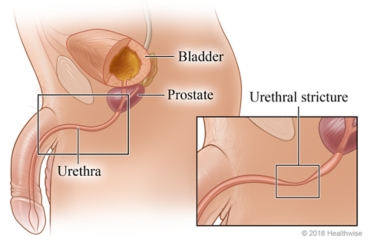
A urethral stricture is a narrowing of the urethra. The urethra is the tube that carries urine from your bladder to outside your body. When something makes the urethra get tighter, it's hard for urine to pass out of your body. Strictures are more common with male anatomy.
What causes it?
Doctors often don't know what causes a stricture. Sometimes it's caused by an injury to the area around the scrotum. An injury can be from a fall, a procedure, or an infection, such as a sexually transmitted infection.
What are the symptoms?
Your urine may come out very slowly or in a weak stream. You may have belly pain from urine building up in your bladder. It may hurt to pass urine. You may have a feeling that you can't empty your bladder. You may also have blood in your urine and have urinary tract infections.
How is it diagnosed?
Your doctor will ask you questions about your medical history. You will also have a physical exam.
Your doctor may check to see how fast urine flows through your urethra. The doctor may measure how much urine is held in your bladder. You may also have an ultrasound or an X-ray test that uses dye. These tests can show how the urine moves through your urethra. Your doctor may also look inside your urethra with a thin, lighted tool called a cystoscope.
After your doctor knows where the problem is, they can suggest treatment.
How is it treated?
Your doctor may recommend urethral dilation. This procedure widens the urethra. A thin tube called a catheter may be left in the urethra for a few days. It helps to keep the urethra open while it heals.
In some cases, the doctor also may do a procedure called a urethrotomy. The doctor uses a thin, lighted tool called a cystoscope. The scope has a special blade at the tip to cut through scar tissue. That can help widen the urethra.
For some people, a device called a drug-coated balloon may be used to stretch the urethra and deliver medicine to the area. This may help prevent the stricture from returning.
If dilation can't be done or doesn't help, you may need surgery to remove the scar tissue. At the same time, your doctor can rebuild the urethra. This is called urethroplasty.
Follow-up care is a key part of your treatment and safety. Be sure to make and go to all appointments, and contact your doctor if you are having problems. It's also a good idea to know your test results and keep a list of the medicines you take.
Clinical Review Board All Ignite Healthwise, LLC education is reviewed by a team that includes physicians, nurses, advanced practitioners, registered dieticians, and other healthcare professionals.
Clinical Review Board All Ignite Healthwise, LLC education is reviewed by a team that includes physicians, nurses, advanced practitioners, registered dieticians, and other healthcare professionals.
This information does not replace the advice of a doctor. Ignite Healthwise, LLC disclaims any warranty or liability for your use of this information. Your use of this information means that you agree to the Terms of Use and Privacy Policy.
The Health Encyclopedia contains general health information. Not all treatments or services described are covered benefits for Kaiser Permanente members or offered as services by Kaiser Permanente. For a list of covered benefits, please refer to your Evidence of Coverage or Summary Plan Description. For recommended treatments, please consult with your health care provider.


 Sign out