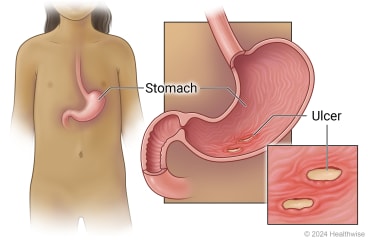
H. pylori tests are used to check for a Helicobacter pylori infection in the stomach and upper part of the small intestine. H. pylori is a type of bacteria that can cause peptic ulcers. But most people who have it in their digestive systems don't get ulcers.
Several tests may be used to check for an H. pylori infection:
Blood antibody test. This checks to see if your child's body has made antibodies to fight H. pylori bacteria.
Urea breath test. This test checks your child's breath to see if your child has H. pylori bacteria in the stomach.
Stool antigen test. This test looks for substances in your child's stool that trigger the immune system to fight an H. pylori infection. (These substances are called H. pylori antigens.)
Stomach biopsy. A small sample (biopsy) is taken from the lining of your child's stomach and small intestine. The samples are checked for H. pylori.
Why is this test done?
H. pylori tests are done to:
Find out if an infection with H. pylori bacteria may be causing an ulcer or irritation of the stomach lining (gastritis).
Find out if treatment for the infection worked.
How do you prepare for the test?
Blood antibody test
Your child doesn't need to do anything before having this test.
Urea breath test, stool antigen test, or stomach biopsy
Medicines your child takes may change the results of these tests. Be sure to tell your doctor about all the prescription and over-the-counter medicines your child takes. Your doctor may ask you to stop giving some of your child's medicines.
Urea breath test or stomach biopsy
You will be asked to not give your child anything to eat or drink for a certain amount of time before the breath test or stomach biopsy. Follow the doctor's instructions about how long your child needs to avoid eating and drinking before the test. If your child will have a stomach biopsy, your doctor will tell you how to prepare for it.
How is the test done?
Blood antibody test
A sample of your child's blood will be taken.
Urea breath test
A breath sample is collected when your child blows into a balloon or blows bubbles into a bottle of liquid. The doctor or nurse will:
Collect a sample of your child's breath before the test starts.
Give your child a pill, a liquid, or some water to swallow that contains tagged material.
Collect more samples of your child's breath. The samples will be tested to see if they contain material formed when H. pylori comes into contact with the tagged material.
Stool antigen test
For this test, you may be asked to collect your child's stool sample at home. To collect the sample, you need to:
Have your child pass stool into a dry container. Either solid or liquid stools can be collected. Be careful not to get urine or toilet paper in with the stool sample.
Replace the container cap. Label the container with your child's name, the doctor's name, and the date the sample was collected.
Wash your hands well after you collect the sample.
Take the sealed container to the doctor's office or to the lab as soon as you can.
Stomach biopsy
A procedure called endoscopy is used to collect samples of tissue from the stomach and the first part of the small intestine. The tissue samples are tested in a lab to see if they contain H. pylori.
Follow-up care is a key part of your child's treatment and safety. Be sure to make and go to all appointments, and call your doctor if your child is having problems. It's also a good idea to keep a list of the medicines your child takes. Ask your doctor when you can expect to have your child's test results.
Clinical Review Board All Ignite Healthwise, LLC education is reviewed by a team that includes physicians, nurses, advanced practitioners, registered dieticians, and other healthcare professionals.
Clinical Review Board All Ignite Healthwise, LLC education is reviewed by a team that includes physicians, nurses, advanced practitioners, registered dieticians, and other healthcare professionals.
This information does not replace the advice of a doctor. Ignite Healthwise, LLC disclaims any warranty or liability for your use of this information. Your use of this information means that you agree to the Terms of Use and Privacy Policy.
The Health Encyclopedia contains general health information. Not all treatments or services described are covered benefits for Kaiser Permanente members or offered as services by Kaiser Permanente. For a list of covered benefits, please refer to your Evidence of Coverage or Summary Plan Description. For recommended treatments, please consult with your health care provider.


 Sign out