Ankle Sprain in Children: Care Instructions

Skip Navigation

Overview

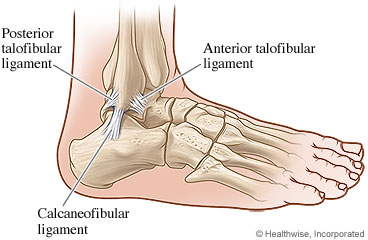
Ligaments of the ankle.

Your child's ankle hurts because they have stretched or torn ligaments, which connect the bones in the ankle.

Ankle sprains may take from several weeks to a few months to heal. Usually, the more pain and swelling your child has, the more severe the ankle sprain is and the longer it will take to heal. Your child can heal faster and regain strength in their ankle with good home treatment.

It's very important to give your child's ankle time to heal completely, so that your child doesn't easily hurt the ankle again.

How can you care for your child at home?

  • Prop up your child's foot on pillows when you ice it or anytime your child sits or lies down during the next 3 days. Try to keep the ankle above the level of your child's heart. This will help reduce the swelling.
  • Your doctor may have given your child a splint, a brace, an air stirrup, or another form of ankle support to protect the ankle until it is healed. Have your child wear it as directed while the ankle is healing. Do not remove it unless your doctor tells you to. After the ankle has healed, ask your doctor if your child should wear the brace while exercising.
  • Put ice or cold packs on your child's injured ankle for 10 to 20 minutes at a time. Try to do this every 1 to 2 hours for the next 3 days (when your child is awake). Put a thin cloth between the ice pack and your child's skin. Keep your child's splint or brace dry.
  • If your child was given an elastic bandage, follow the doctor's directions for wearing it. The bandage should be snug but not so tight that it causes numbness or tingling. To rewrap the ankle, begin at the toes and wrap around the ankle in a figure-eight pattern, ending several inches above the ankle.
  • Your child may have to use crutches until your child can walk without pain. While using crutches, your child should try to bear some weight on the injured ankle if they can do so without pain. This helps the ankle heal.
  • Be safe with medicines. Read and follow all instructions on the label.
    • If your child is not taking a prescription pain medicine, ask your doctor if your child can take an over-the-counter medicine.
    • If the doctor gave your child a prescription medicine for pain, give it as prescribed.
    • Store your child’s prescription pain medicines where no one else can get to them. When you are done using them, dispose of them quickly and safely. Your local pharmacy or hospital may have a drop-off site.
  • If your child has been given ankle exercises to do at home, make sure your child does them exactly as instructed. These can promote healing and help prevent lasting weakness.

When should you call for help?

Contact your doctor now or seek immediate medical care if:

  • Your child has new or worse pain.
  • Your child's foot is cool or pale or changes color.
  • Your child has tingling, weakness, or numbness in the toes.
  • Your child has a problem with their splint or cast.
  • Your child has signs of a blood clot in the leg (called a deep vein thrombosis), such as:
    • Pain in the calf, back of the knee, thigh, or groin.
    • Swelling in the leg or groin.
    • A color change on the leg or groin. The skin may be reddish or purplish.

Watch closely for changes in your child's health, and be sure to contact your doctor if:

  • Your child does not get better as expected.

Where can you learn more?

Go to http://www.healthwise.net/patientEd

Enter S058 in the search box to learn more about "Ankle Sprain in Children: Care Instructions".

Current as of: March 12, 2026

Author: WebMD Ignite Staff

Clinical Review Board
All WebMD Ignite education is reviewed by a team that includes physicians, nurses, advanced practitioners, registered dieticians, and other healthcare professionals.


Current as of: March 12, 2026

Author: WebMD Ignite Staff

Clinical Review Board
All WebMD Ignite education is reviewed by a team that includes physicians, nurses, advanced practitioners, registered dieticians, and other healthcare professionals.

The Health Encyclopedia contains general health information. Not all treatments or services described are covered benefits for Kaiser Permanente members or offered as services by Kaiser Permanente. For a list of covered benefits, please refer to your Evidence of Coverage or Summary Plan Description. For recommended treatments, please consult with your health care provider.