


 Sign out
How remote monitoring helped one mom through a high-risk pregnancy
Alicia Saunders delivers a healthy baby boy thanks to virtual touchpoints and frequent in-person appointments.
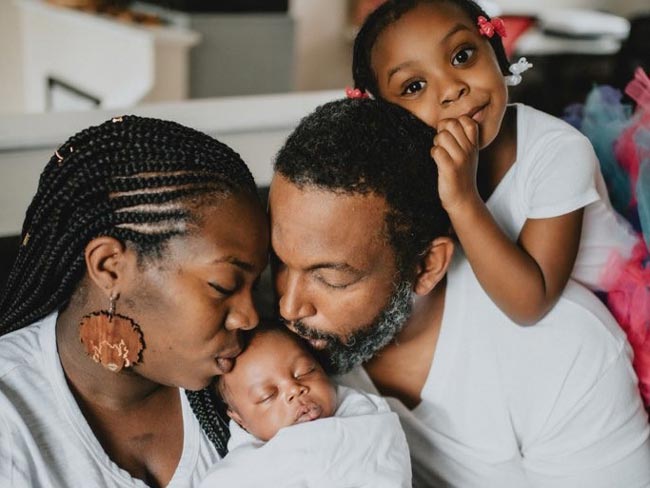
Alicia Saunders and her husband, David, and daughter, Zoe, welcomed Kody in 2021.
Alicia Saunders felt a mix of emotions when she learned she was pregnant with her third child.
Less than a year earlier, her second child, Olivia, had been stillborn because of an umbilical cord abnormality. The pain of that loss was fresh for Saunders.
Adding to her worry was the knowledge that her third pregnancy was high risk.
A high-risk pregnancy means the mother or baby has an increased chance of a health problem.
Factors that can make a pregnancy high risk include:
- Being younger than 17 or older than 35
- Health problems such as diabetes or high blood pressure
- Smoking or vaping, drinking alcohol, or taking certain medications
- Problems in past pregnancies, such as preterm labor or preeclampsia
At age 36, Saunders was considered of “advanced maternal age.” She also had gestational diabetes and a history of preeclampsia (a pregnancy complication characterized by high blood pressure).
Remote monitoring enhances perinatal care
An innovative remote monitoring program helped ease her worries.
Saunders was given Bluetooth-enabled blood pressure and blood sugar monitors to use at home. The monitors sent readings to her electronic health record through an app on her smartphone, allowing her care team to monitor her pregnancy between office visits.
“Being pregnant after a loss is a lot, both physically and emotionally,” said Saunders. “I definitely appreciated having more frequent contact with my care team.”
Saunders began each day by checking her blood pressure and blood sugar. She checked it again after meals and before she went to sleep.
“If any of my numbers were high or low, I would get a phone call,” she said. “And if the nurses were still concerned after asking me some questions, they would tell me to come in.”
Increased risk of pregnancy complications for Black women
High blood pressure and diabetes during pregnancy are leading risk factors for maternal mortality. Black women in the United States have higher rates of these conditions than white women. They are also more than 3 times more likely to die during and after pregnancy.
“Remote monitoring has been transformative in how we’re able to manage high-risk patients like Alicia,” said Bindu Bareddy, MD, Saunders’ ob-gyn at Kaiser Permanente in Georgia.
“Going to a doctor’s appointment can take half a day,” she added. “That’s difficult for patients who work or have children when all that may be needed is to check their blood pressure or blood sugar level. This program improves convenience for our patients and lets us be present in their care even outside of scheduled appointments.”
Frequent in-person appointments for high-risk moms
While remote monitoring provides additional touchpoints between patients and their care teams, it doesn’t take the place of in-person visits.
“We start out seeing our high-risk moms every 4 weeks. That increases to every 2 weeks, then weekly, and by 32 weeks, we’re seeing them twice a week,” said Dr. Bareddy. “We check the baby’s heartbeat, look at the amniotic fluid, and if we see anything concerning, we send the mom on to a high-risk specialist.”
Saunders appreciated the reassurance these appointments provided.
“A couple of times, if the baby wasn’t moving as much, my husband and I would get scared, and we’d go in. The care team never made me feel like I was overreacting. They told me, ‘You can come in as often as you want or need.’”

A healthy baby boy
Saunders’ anxiety grew as her pregnancy approached 36 weeks, when Olivia’s stillbirth had occurred. At 35 weeks, Saunders gave birth to Kody, a healthy baby boy.
“A rainbow baby is a baby born after a loss,” she explained. “Kody is our rainbow baby, and I think he knew how much we needed him to get here.”
Now a mom of 4, Saunders serves on a patient advisory council at Kaiser Permanente focused on enhancing perinatal safety and improving the maternity experience.
“I personally experienced a high-risk pregnancy, and I benefited from remote monitoring,” she said. “It makes me jump for joy to know that other moms will have that peace of mind.”