


 Sign out
For cardiac patients, TAVR surgery offers easier recovery
Ed Dalmasso needed an aortic valve replacement. His care team provided a much less invasive alternative to open-heart surgery.
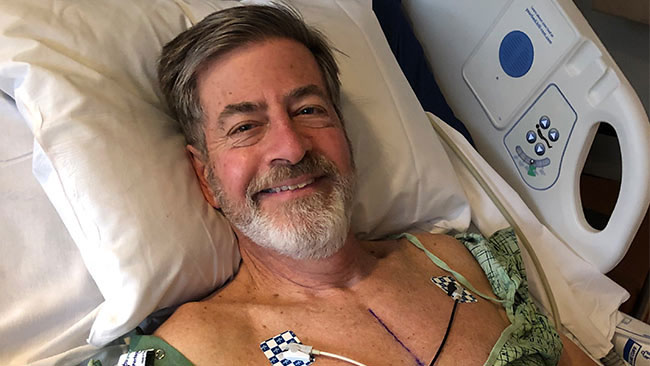
Dalmasso recovered quickly from his procedure, and he was soon back to enjoying his active life.
Ed Dalmasso is an engineer in his 70s who enjoys tinkering on projects and working in his backyard. But in November 2021, he began feeling tired and getting winded more quickly than usual.
Dalmasso has a history of heart disease. He had a heart attack at 51, followed by 2 open-heart bypass surgeries. But he recovered well and didn’t think the new symptoms had anything to do with his heart.
“I thought I was just starting to feel my age a bit,” he said. “But I went in to see my doctor to get checked out.”
His doctor detected a heart murmur and ordered an echocardiogram, an ultrasound that shows how the heart’s muscles and valves are working.
The test revealed a narrowing of his aortic valve, which connects the heart to its main artery.
The condition, known as aortic valve stenosis, reduces blood flow. It becomes more common as people get older, and it forces the heart to work harder to pump the same amount of blood. This increased strain can damage the heart. And it can even lead to heart failure.
In severe cases like Dalmasso’s, the recommended treatment is valve replacement.
Helping patients avoid open-heart surgery
Considering Dalmasso’s age and previous surgeries, cardiologist Benjamin Galper, MD, decided he was a good candidate for TAVR, short for transcatheter aortic valve replacement.
With TAVR, an interventional cardiologist can replace a heart valve quickly and safely with only a tiny incision in the leg artery. The cardiologist delivers the replacement valve through the patient’s leg with the help of X-ray cameras.
TAVR has become increasingly common since it was developed more than 20 years ago because it provides several benefits over open-heart procedures.
It’s far less invasive and requires only a small cut. During an open-heart surgery, on the other hand, a surgeon cuts through the breastbone and spreads the rib cage to access the heart.
TAVR leaves smaller scars and poses a lower risk of infection.
TAVR heart procedure offers easier recovery
Cardiologists at Kaiser Permanente have become experts at TAVR, performing the procedure hundreds of times over the past decade.
The time from referral to the procedure is typically a month or less.
They did my TAVR procedure and then released me from the hospital the next day, which seemed like a miracle. Ed Dalmasso
“Patients meet with our interventional cardiologist and cardiac surgeon and get all their imaging done on the same day,” said Scott Haugen, MD, chief of cardiology for Kaiser Permanente in Washington.
Outside of Kaiser Permanente’s integrated system, that would often require 3 or 4 separate visits.
“Everything was very smooth,” Dalmasso said. “My coordinator scheduled all my appointments and explained everything that would happen.”
The hospital stay for TAVR patients is shorter than for patients who have open-heart surgery, who often stay in the hospital for a week or more.
“Our patients usually stay in the hospital just one night, so they can recover at home with their families,” Dr. Galper said.
Quick recovery at home from TAVR
Dalmasso said every part of his experience went smoothly.
“They did my TAVR procedure and then released me from the hospital the next day, which seemed like a miracle,” he said.
Dalmasso didn’t feel any pain after his treatment and was able to walk the very next day. Just 2 weeks after his heart murmur was detected, he was back to his normal life.
He goes on long walks almost every day, enjoying exploring the hilly, forested land behind his home. And he’s back to working in his yard and on home projects.
“I feel like myself again,” he said.
Learn more about heart health and cardiac care at Kaiser Permanente.
Symptoms of aortic stenosis
Aortic valve stenosis takes a long time to develop, and you may not have symptoms for many years.
But as the problem gets worse, you may have symptoms such as:
- Chest pain or pressure
- Dizziness
- Lightheadedness
- Fatigue
- Shortness of breath
Symptoms often occur during exercise or strenuous movement, when the heart has to work harder.
Causes of aortic stenosis
Aortic valve stenosis can be caused by:
- Calcium buildup on the valve, which becomes more common as we age
- A heart defect that you were born with, such as a bicuspid aortic valve
- Rheumatic fever, which can create scar tissue on the valves of the heart