


 Sign out
Facing breast cancer while pregnant
A team of specialists treats an expecting mother’s cancer while keeping her growing baby safe.
A long-awaited pregnancy takes an unexpected turn when Maria Cobos finds a lump in her breast.
Maria Cobos was eager to start a family with her new husband. But after 2 miscarriages, she worried that it might not happen.
“Then I was able to get pregnant the third time around, and we were so happy that the baby stayed,” she said.
But Cobos’ journey was just beginning.
At the start of her second trimester, she found a lump in her breast. Her ob-gyn was concerned and referred her to a breast specialist who recommended a mammogram, ultrasound, and biopsy. The diagnosis was breast cancer.
“I felt so depressed that I couldn’t even eat or sleep,” said Cobos. “I didn’t know if I was going to die or if the baby would be OK.”
Cobos felt relieved after meeting with surgical oncologist Brooke Vuong, MD.
“She explained what type of cancer I had and reassured me that it was treatable,” Cobos said.
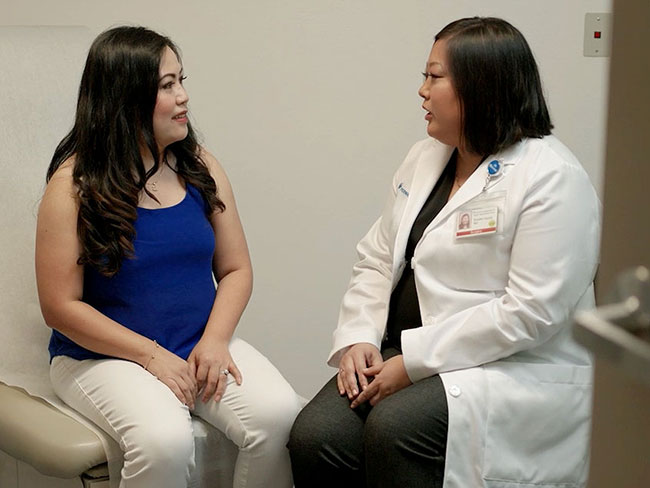 Cobos with her surgical oncologist, Dr. Vuong.
Treating breast cancer during pregnancy
Breast cancer is one of the most common cancers diagnosed during pregnancy. It occurs in about 1 out of every 3,000 pregnancies, most often in women ages 32 to 38 years.
Cancer can usually be treated safely during pregnancy, but the type and timing of treatment might be affected by the pregnancy.
A team of cancer specialists working together
To ensure a treatment plan that would keep both Cobos and her baby safe, Dr. Vuong presented the case during a multidisciplinary breast care conference at the Kaiser Permanente South Sacramento Medical Center.
“This is a regular meeting attended by all the physicians who treat breast cancer patients,” Dr. Vuong explained. “We review each patient’s case as a team and come up with a care plan.”
Multidisciplinary breast care conferences take place at other medical centers across Kaiser Permanente. Participants may include breast surgeons, medical and radiation oncologists, radiologists, pathologists, genetic counselors, plastic surgeons, social workers, psychologists, and other members of the care team.
“In Maria’s case, I also consulted with a physician who specializes in high-risk pregnancies,” Dr. Vuong said. “We discussed the sequence of Maria’s treatment and when she should deliver her baby.”
Supporting mom and baby with a coordinated plan
Chemotherapy can sometimes be an option during pregnancy. For Cobos, it wasn’t a good choice due to her specific cancer.
Instead, her care team recommended surgery to remove the tumor in her breast as she approached her third trimester of pregnancy. Breast surgery is generally considered safe during the second trimester or early in the third trimester of pregnancy.
“As an extra precaution, the neonatology team joined us during the surgery in case Maria needed to have an emergency delivery,” said Dr. Vuong.
Everything went smoothly. Eight weeks later, Cobos was induced and gave birth to a healthy baby boy named Troy.
After the birth, her treatment continued with chemotherapy, radiation, and targeted therapy for her cancer.
Today, Cobos is cancer-free and grateful for the care she received.
“This is the happiest moment in my life,” she said.