Sign out

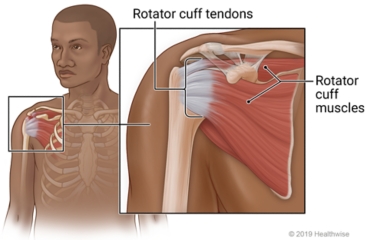
What is rotator cuff rehabilitation?
Rotator cuff rehabilitation is a series of exercises you do after your surgery. It helps you get back your shoulder's range of motion and strength. You will work with your doctor and physical therapist to plan this exercise program. To get the best results, you need to do the exercises correctly and as often as your doctor tells you.
Before you start any exercises, talk with your doctor or physical therapist. It is important that you know exactly how to do the exercises. Stop and call your doctor if you are not sure that you are doing the exercises correctly or if you have any pain. Hearing clicks and pops during exercise is not always cause for concern, but a grinding feeling may mean a more serious problem. Ice your shoulder after exercising if it is sore.
Follow-up care is a key part of your treatment and safety. Be sure to make and go to all appointments, and call your doctor if you are having problems. It's also a good idea to know your test results and keep a list of the medicines you take.
Stretching exercises
Do not start doing stretching exercises until your doctor says you can. Your doctor will tell you which exercises to do, and how often and how long to do them.
Posterior stretch
- Stand upright with your feet shoulder-width apart.
- Put the hand of your affected arm on the opposite shoulder, and hold the elbow to your body.
- Then, using your good arm, hold the elbow of your affected arm and move it gently up, away from, and across your body.
External rotation
- Hold a lightweight stick or rod in your good arm. It should be about 2 feet long. A curtain rod may work well.
- Lie on your back with your elbows next to your sides. Rest the elbow of your affected arm on a small pillow or folded towel.
- Set your arms so that the elbows are bent at a 90-degree angle, like the letter "L." Your hands will point straight up.
- Hold the stick with both hands. Use your good arm to push the stick toward the affected arm so the affected arm moves outward, away from your body. Stop when you feel the arm stretching.
Strength exercises
Do not start strength exercises until your doctor says you can. Usually, this is several weeks after surgery. Your doctor will tell you how often and how long to do the exercises.
Arm raises to the side
- Stand upright with your feet shoulder-width apart and your affected arm at your side.
- Slowly raise your injured arm to the side, with your thumb facing up. Raise your arm 60 degrees at the most (shoulder level is 90 degrees).
- After holding the position for 3 to 5 seconds, lower your arm back to your side. If you need to, bring your "good" arm across your body and place it under the elbow as you lower your injured arm. Use your good arm to keep your injured arm from dropping down too fast during the downward motion.
- Repeat 8 to 12 times.
- When you first start out, don't hold any additional weight in your hand. As your strength improves, you may use a 1- to 2-pound dumbbell or a small can of food.
Shoulder flexor
- Stand facing a wall. Your body should be about 6 inches away from the wall.
- Keep your affected arm and elbow to your side, and bend your elbow so that your arm is pointing toward the wall.
- Make a closed fist with your thumb on top.
- Push your hand into the wall and hold it for 6 seconds. Push with 25% to 50% of the force you have.
Shoulder extension
- Stand with your back flat against a wall.
- Keep your affected arm and elbow at your side, and bend your elbow so that your upper arm is against the wall and your lower arm is pointing straight ahead. Make a closed fist with your thumb on top.
- Push your elbow gently back against the wall, holding for 6 seconds. Push with 25% to 50% of the force you have.
Where can you learn more?
Go to http://www.healthwise.net/patientEd
Enter L805 in the search box to learn more about "Rotator Cuff Rehabilitation".
Current as of: July 17, 2023
Author: Healthwise Staff
Clinical Review Board
All Healthwise education is reviewed by a team that includes physicians, nurses, advanced practitioners, registered dieticians, and other healthcare professionals.