Sign out

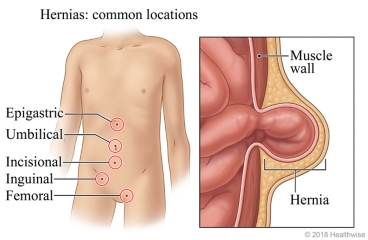
How can you care for your child at home?
 Activity
- Allow your child's body to heal. Don't let your child move quickly or lift anything heavy until he or she is feeling better.
- Have your child rest when he or she feels tired.
- Have your child try to walk a little each day.
- The time it takes for your child to heal depends on the type of hernia. Your doctor will tell you when your child can return to normal activity.
- Your child may shower 48 hours after surgery, if the doctor okays it. Pat the incision dry. Your child should not swim or take a bath for the first 2 weeks, or until the doctor tells you it is okay.
 Diet
Diet
- Your child can eat a normal diet. If your child's stomach is upset, try bland, low-fat foods like plain rice, broiled chicken, toast, and yogurt.
- If your child's bowel movements are not regular right after surgery, you can help him or her to avoid constipation and straining. Have your child drink plenty of water. The doctor may suggest fiber, a stool softener, or a mild laxative.
 Medicines
- Your doctor will tell you if and when your child can restart his or her medicines. The doctor will also give you instructions about your child taking any new medicines.
- Be safe with medicines. Have your child take medicines exactly as prescribed. Call your doctor if you think your child is having a problem with his or her medicine. You will get more details on the specific medicines your doctor prescribes.
 Incision care
- If your child's cut (incision) was closed with skin glue, the glue will wear off in a few days to 2 weeks. Do not put antibiotic ointment or cream on the glue.
- If there are strips of tape on the cut the doctor made, leave the tape on for a week or until it falls off.
- If there are staples closing the cut, you will need to see the doctor in 1 to 2 weeks to have them removed.
- Wash the area daily with warm water, and pat it dry. Don't use hydrogen peroxide or alcohol. They can slow healing.
- You may cover the area with a gauze bandage if it oozes fluid or rubs against clothing. Change the bandage every day.
When should you call for help?

Call 911 anytime you think your child may need emergency care. For example, call if:
- Your child passes out (loses consciousness).
- Your child is short of breath.
Call your doctor now or seek immediate medical care if:
- Your child has pain that does not get better after he or she takes pain medicine.
- Your child has loose stitches, or the incision comes open.
- Your child has signs of infection, such as:
- Increased pain, swelling, warmth, or redness.
- Red streaks leading from the incision.
- Pus draining from the incision.
- A fever.
- Bright red blood has soaked through the bandage.
- Your child cannot pass stools or gas.
- Your child is sick to the stomach or cannot drink fluids.
- Your child has signs of a blood clot in the leg (called a deep vein thrombosis), such as:
- Pain in the calf, back of the knee, thigh, or groin.
- Redness and swelling in the leg or groin.
Watch closely for changes in your child's health, and be sure to contact your doctor if your child has any problems.
Current as of: July 26, 2023
Author: Healthwise Staff
Clinical Review Board
All Healthwise education is reviewed by a team that includes physicians, nurses, advanced practitioners, registered dieticians, and other healthcare professionals.